
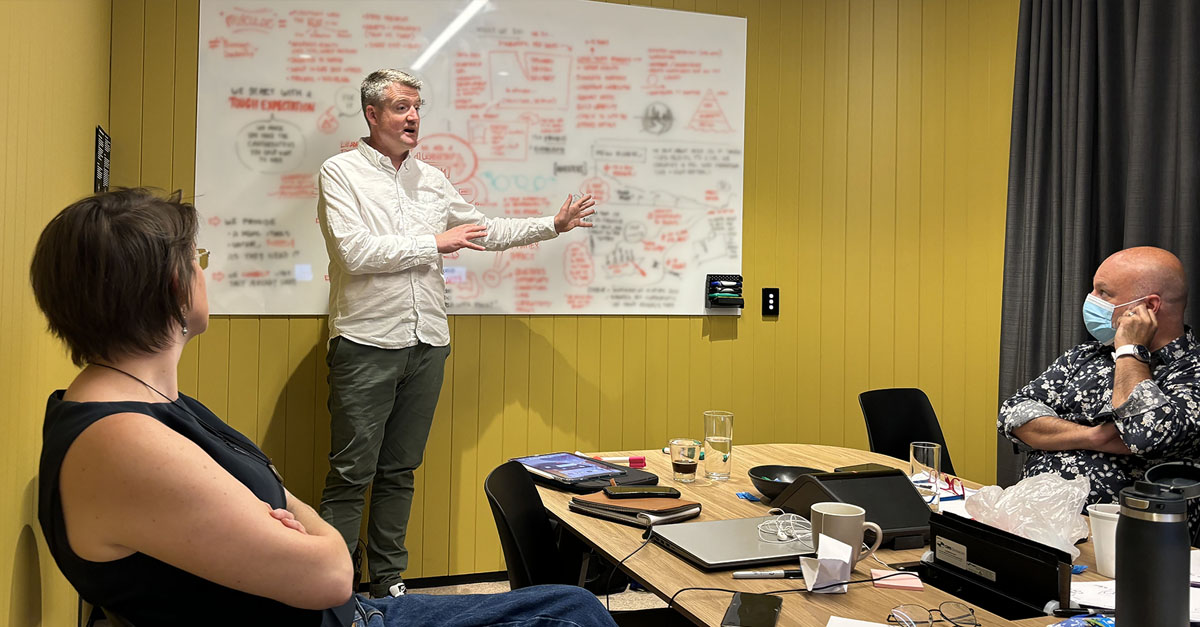
As someone who works as a visual strategist, graphic recorder, facilitator, and business illustrator, I’ve wrestled with the issue of “AI taking my job” a lot. When clients can ask AI to summarise meetings, generate visuals, draft communications, even propose strategies, where does that leave folks like us?
Be more human, Ben!
I’ve read and heard a lot of advice floating around for creative professionals , about how to deal with this. We're told to “be more human”, “be more authentic”, and “lean into vulnerability”.
That all sounds very nice. And that might work for you. But personally, I've never found it very useful.
I want to add my voice to the chorus you've probably heard, that our roles as creative professionals are not obsolete, just repositioned. And it's not about Us-versus-AI, or trying to work without AI (I'll save that for another post), but using AI to our advantage. BUT what does that mean in practice? Well, here are 3 ways that have worked for me to do more of what clients actually value, and more of what AI can't meaningfully replace.
1. Be the strategic insight partner with “What, So What, Now What”
There's an assumption that clients hire creatives to produce things more quickly, cheaply, efficiently. And to some extent, true. BUT what they often want (and need) is a thought partner.
Someone who can ask questions, listen, discuss, ask more questions, distill, reflect, and help them make sense of it all. Someone who can turn complex business/technical mush into meaningful magic.
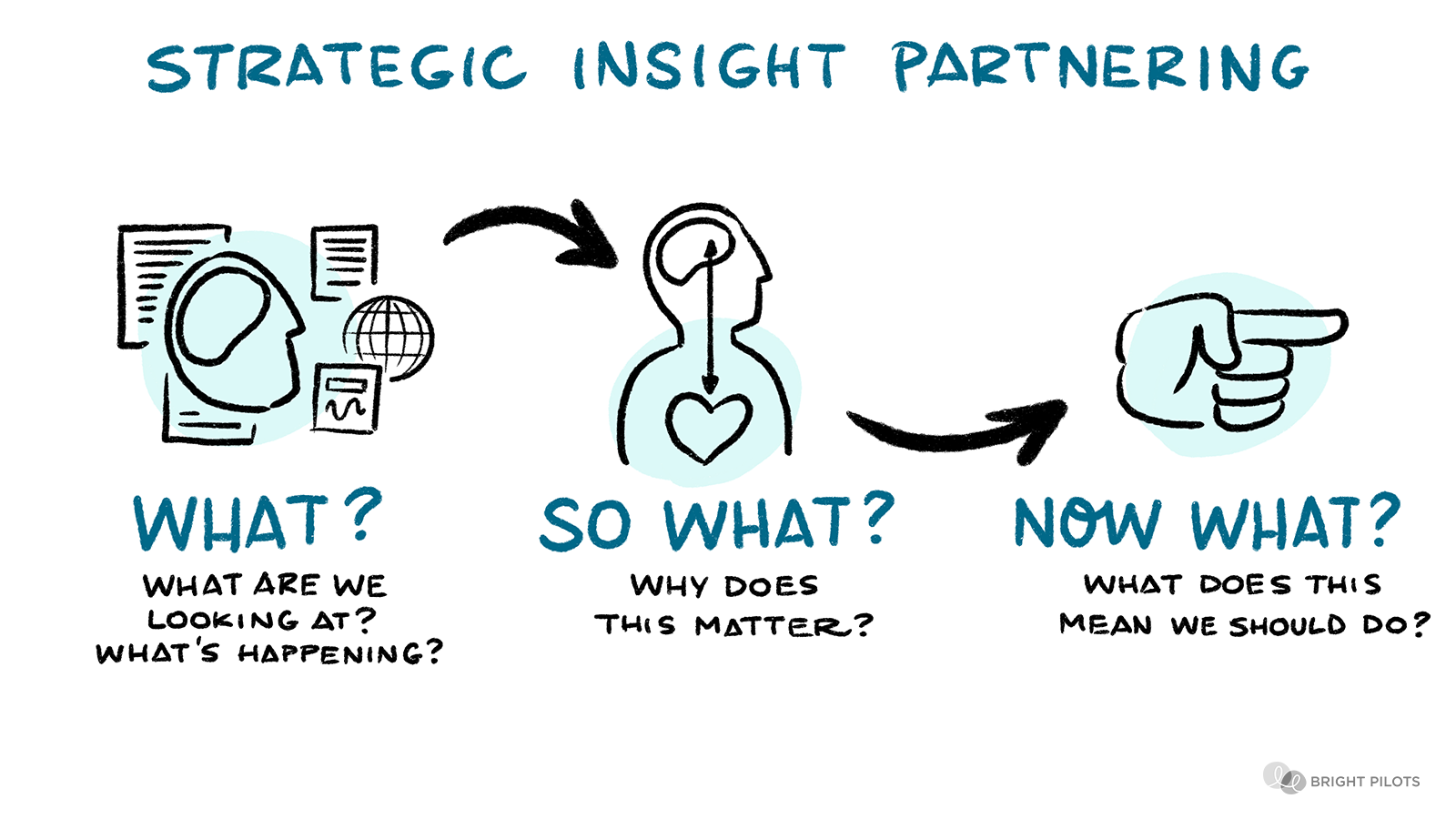
The What, So What, Now What framework
One of the simplest tools I use over and over again in different ways is the What, So What, Now What framework:
- What? What are we looking at? What’s happening?
- So what? Why does this matter?
- Now what? What does this mean we should do?
It’s super simple, and easy to remember, but really powerful.
Example: I was once working with a client designing the agenda for a strategic planning session. It was all very sensible, and colour-by-numbers. But then I asked: “Imagine we’re at the end of this session and we have a set of goals. Now what? What will make these goals more achievable across your organisation? And what could we build into the session to increase the likelihood of success?”
That shifted everything.
Instead of just designing a workshop, we zoomed out, and started designing for implementation, ownership, and alignment.
AI can have a conversation with you (or let's not forget, the illusion of a conversation). It can ask you questions and use your responses to generate its next response, generate ideas, and propose agendas. But it doesn’t detect any logical or cultural tensions in the conversation. It doesn’t feel the gap between aspiration and reality. It doesn’t notice when an individual or a group is designing something that looks good on paper but won’t survive contact with culture.
You can reclaim your role as strategic insight partner, the person who helps clients think better, not just produce faster.
2. Architect novelty with “Odd Couples”
Let’s be honest, a lot of corporate communication is the same. Thing. Every. Damn. Time. And engagement drops because of it. As I'm sure you've found, bringing AI into the office has only meant more of the same.
The antidote I've always found is novelty. Novelty wakes people up, and sparks their curiosity.
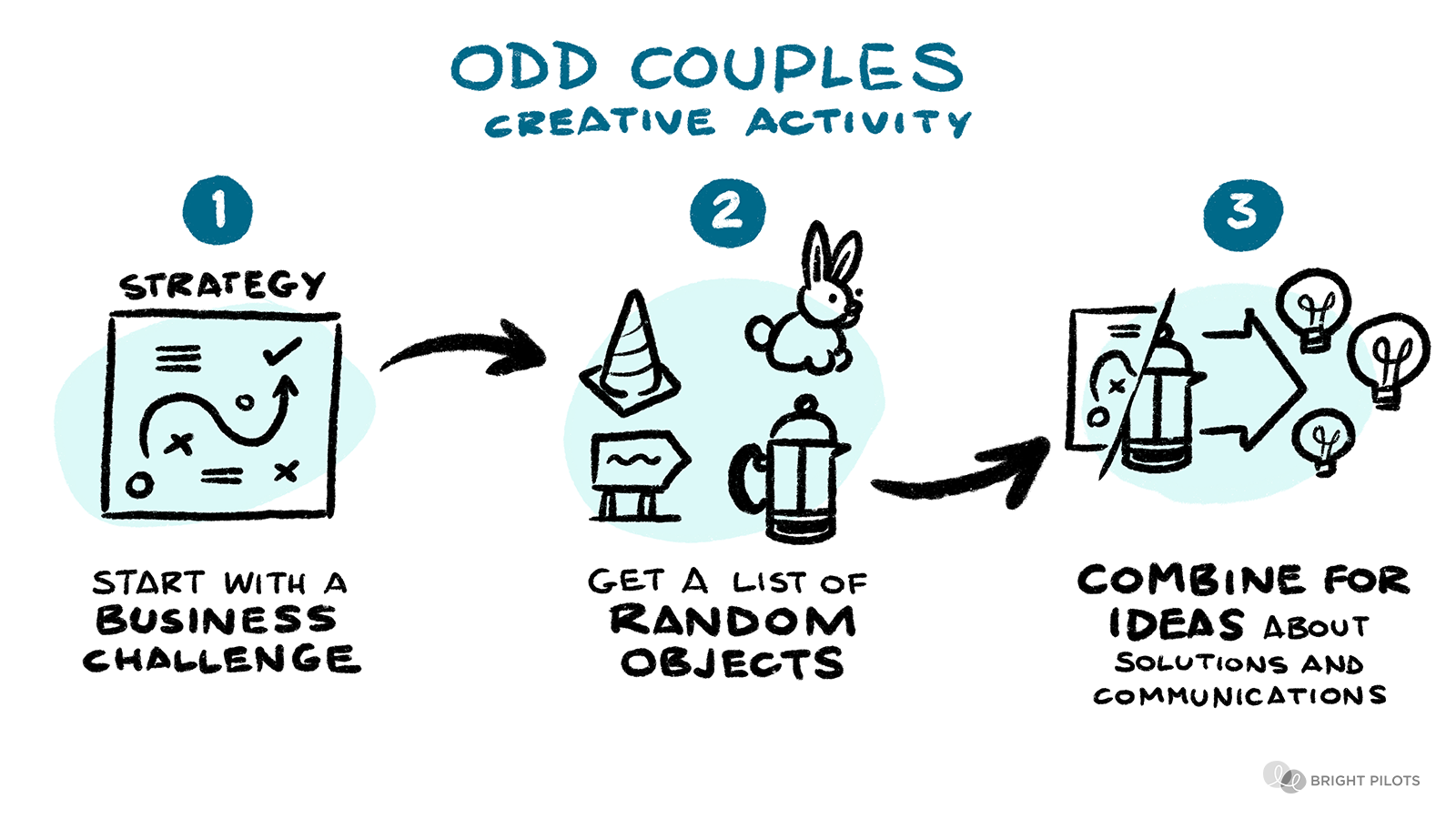
The Odd Couples creative activity
To be clear, I don't mean being all whacky and zany at work - nobody wants that. That said, we can still architect slight intriguing twists in our approaches to problem-solving and communication. Of my favourite ways of doing this is a 2-step creative exercise called Odd Couples. It's basically about taking a familiar topic, and then combining it with something completely unrelated to find a novel connection. You start with whatever it is you have to solve, and/or communicate (I'll call it a business challenge).
That could be:
- A strategic plan;
- A system change; or
- A complex project roadmap
Step 1: Come up with a list of random objects. For example:
- A traffic cone;
- A rabbit;
- A street sign; or
- A French press coffee pot
You can come up with that list yourself (or collect ideas from a group of people in a meeting), or if you must, ask AI to generate a random list of objects.
Step 2: Combine your business challenge with a random object from the list. Yes really! Think about how that object as a metaphor might help to reshape your thinking and communication about your business challenge.
For example:
System change + French press coffee pot? Now we’re talking about: The change is like downward pressure. Sediment is compacted. This might be uncomfortable, but it's a slow process, so that there is time to steep, and get used to this pressure. That pressure actually unlocks more richness and flavour than if there was no pressure in the system.
Can you see how that metaphor alone can unlock an entirely different way to communicate the change?
Again, you could always prompt AI to give you ideas instead, for how the random object as a metaphor can reframe the business challenge, but I think you'd be missing out.
The thing to remember here with architecting novelty is that you are the architect. You are choosing the collision and combination of object and business challenge. You are interpreting the metaphor. You are designing the meaning. While AI is an idea-creation tool, you stay the creative director. When you consciously combine familiar with unfamiliar, you reclaim your role as innovative idea generator, not by outproducing AI, but by outframing it.
3. Use your X-Ray vision
AI is good at summarising meetings, but it's not good at reading the room. As humans in meetings, we're doing a lot more than just taking in information and making sense of it. We're not just looking at a situation, we're looking through it.
We notice body language. We sense hesitation. We feel friction. We hear what isn’t being said.
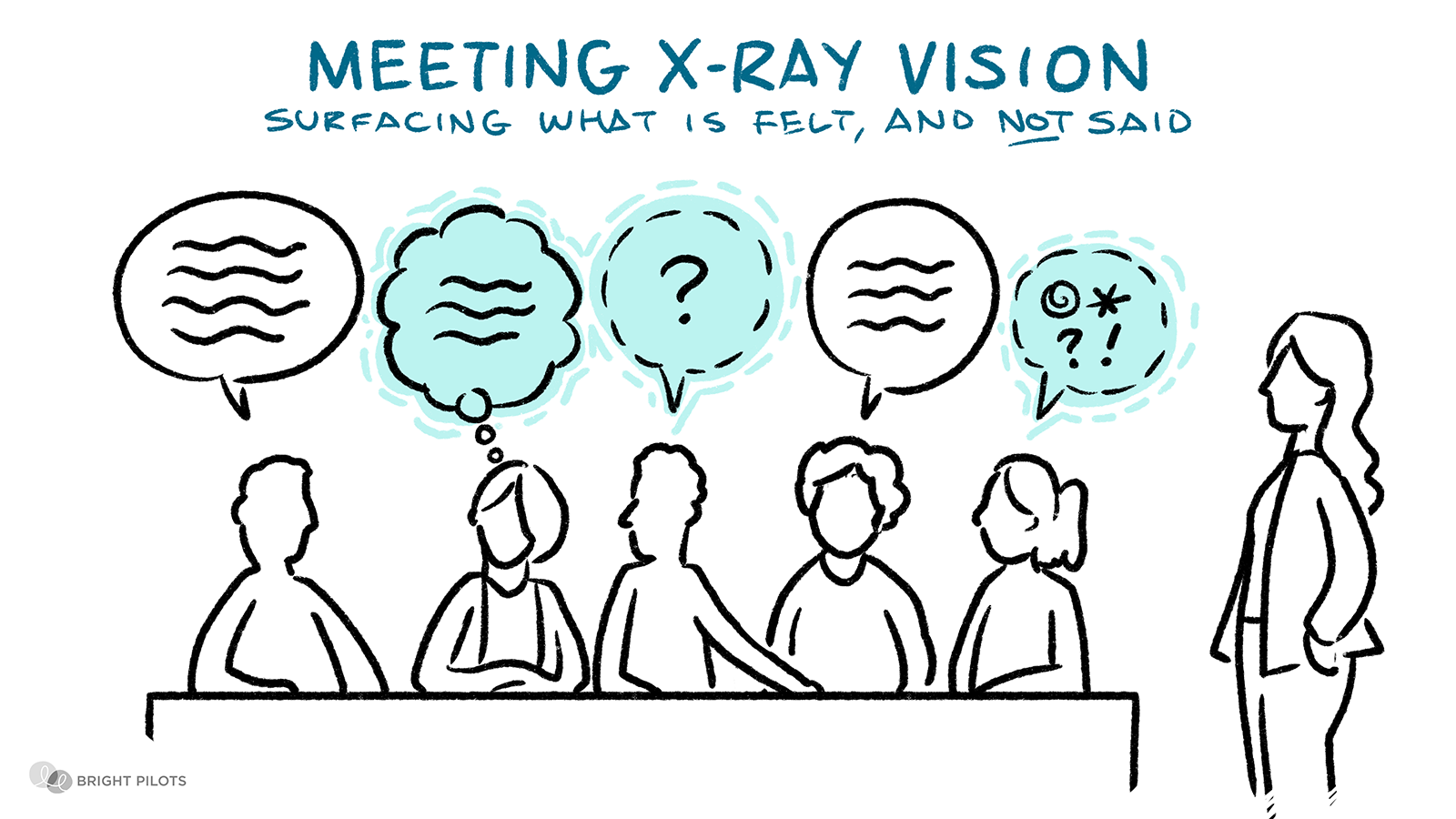
You are already using your Meeting X-Ray Vision...
I recently facilitated a strategic planning session with an executive team in the education sector. They had lots of goals, which I captured faithfully on the whiteboard.
But something felt off. The energy in the room didn’t match the ambition of the words. So I used one of my favourite facilitatory questions in times like these:
“What are we not talking about?”
Once people responded to that, it became clear that many in the room didn't feel included in the decision-making culture of the organisation. It was awkward at first, but it was still a big breakthrough, that then shifted the conversation in a really healthy way.
Then, I asked another favourite facilitatory question:
“What should we now do differently in this strategic planning session?”
We tore up the afternoon's agenda, and instead focused on inclusion, setting clear expectations across roles, and decision-making dynamics.
Did we “achieve” everything we’d planned to? No. But did we surface something far more important than the initial plan? Absolutely.
Now, the thing is, AI would have summarised the existing conversation into a neat set of points and actions. But it would not have sensed the exclusion, and awkward energy. It would not have paused the meeting and asked an awkward probing question. And it would not have given the group permission to confront something uncomfortable in a safe way, and re-gear the rest of their time to discuss something far more important.
That's where our very human skill of ‘X-Ray vision’ at work is so hugely valuable. It makes us a powerful catalyst, an important pattern-spotter, a brave mirror, and a crucial sense-maker. You are the person who can safely surface what’s invisible, exercising professional judgment, rooted in lived experience.
Pretty valuable, no?
Change the race
I hope these three examples - being a strategic insight partner, architecting novelty, and using your X-ray vision - help to make you more aware of some fantastic skills you already have that you can really lean into.
And I hope this makes it easier to see more clearly what to be nervous about and what not to be nervous about when it comes to AI. If you’re nervous competing with AI on speed, volume or cheapness, you will feel behind, and fall behind.
But if you focus on strategic insight, creative experiences and processes, and contextual judgment, then you're well and truly in terrain that AI can’t occupy AND in areas that clients really value more.
So, power on! And let me know if you want to level up in these areas even more.