

I was catching up with a client recently about a big change they are in the middle of making throughout the organisation. Based on the various challenges that were vexing them, I thought I'd show them my Performance Canvas. Turns out this canvas works really well for diagnosing and helping with issues to do with change management too.
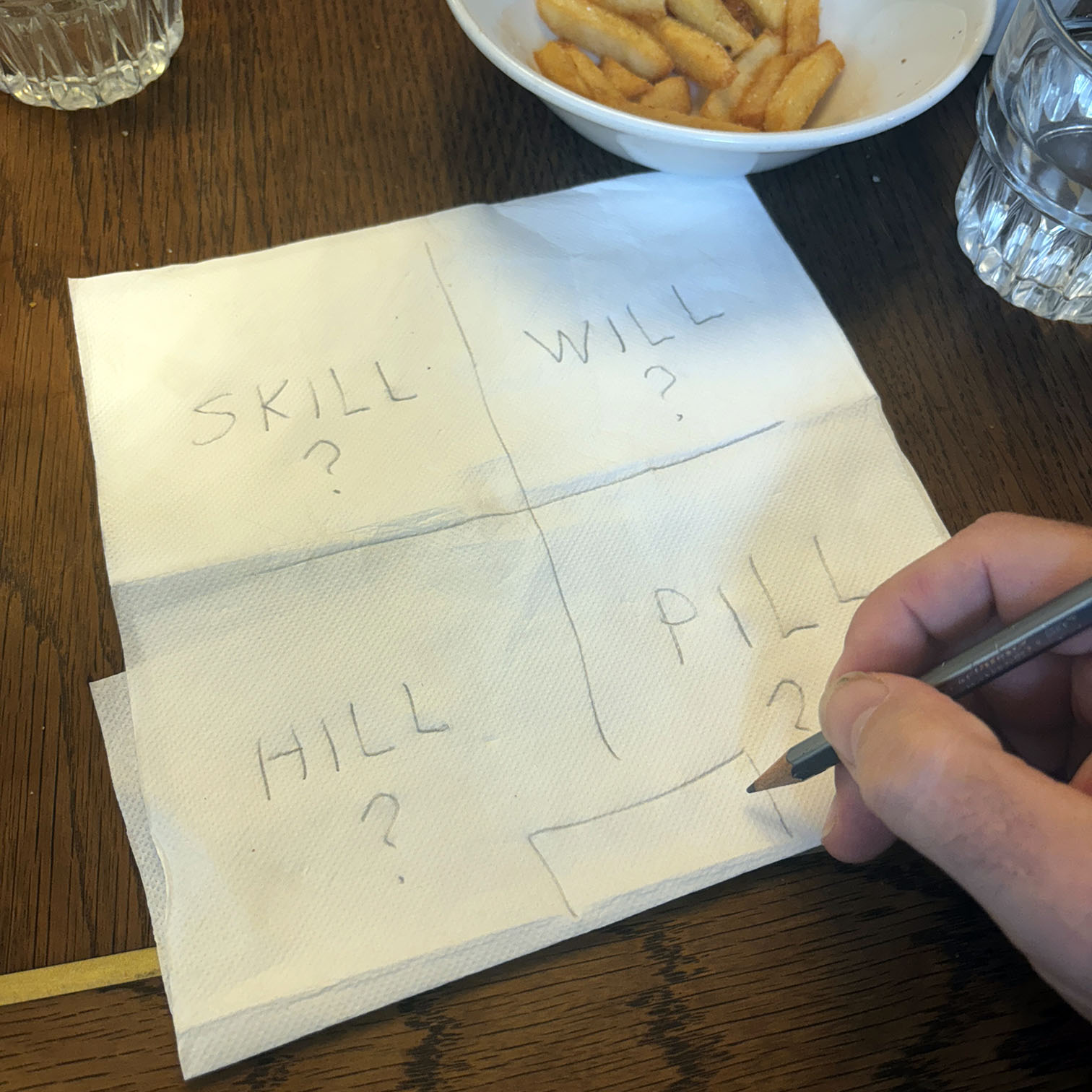
Yes, I actually explained the Performance Canvas to a client on a napkin
Building on the Skill/Will Matrix
As I’m sure many of you in coaching, change management and L&D circles know, the Skill/Will Matrix comes in handy here, for understanding where people are at with performance in any given area. The Skill/Will Matrix was popularised by Max Landsberg in his book, The Tao of Coaching, based on earlier work by Paul Hersey and Ken Blanchard in the 1970s, in their book Situational Leadership Model.
I adapted this Matrix to also include ‘Hill’ and ‘Pill’ (see below), because in my consulting experience, I found that there was always more to the challenge of productivity and/or change than just aptitude and motivation.
In other words, you can’t just throw training at the problem!
The Performance Canvas
The Performance Canvas is made up of five prompts:
- SKILL - Are staff appropriately skilled up? Do they have the right domain knowledge? Do they know how to use whatever systems and processes are needed? They might be skilled enough, but...
- WILL - Are they motivated enough? Is there enough extrinsic and intrinsic incentive for them to perform to the level needed, or change what they've been doing to a new way? If so, that's a win, but...
- HILL - What's the environment like, for them to perform or change? Is there too much friction in the system outside of their control that they have to grapple with, such as fragmented platforms, opaque approval processes, or the struggles of hybrid work? And if all of that is going swimmingly well...
- PILL - What day-to-day tools and templates do they have on hand to help them on a day-to-day basis?
- GOAL - What are the staff meant to achieve?
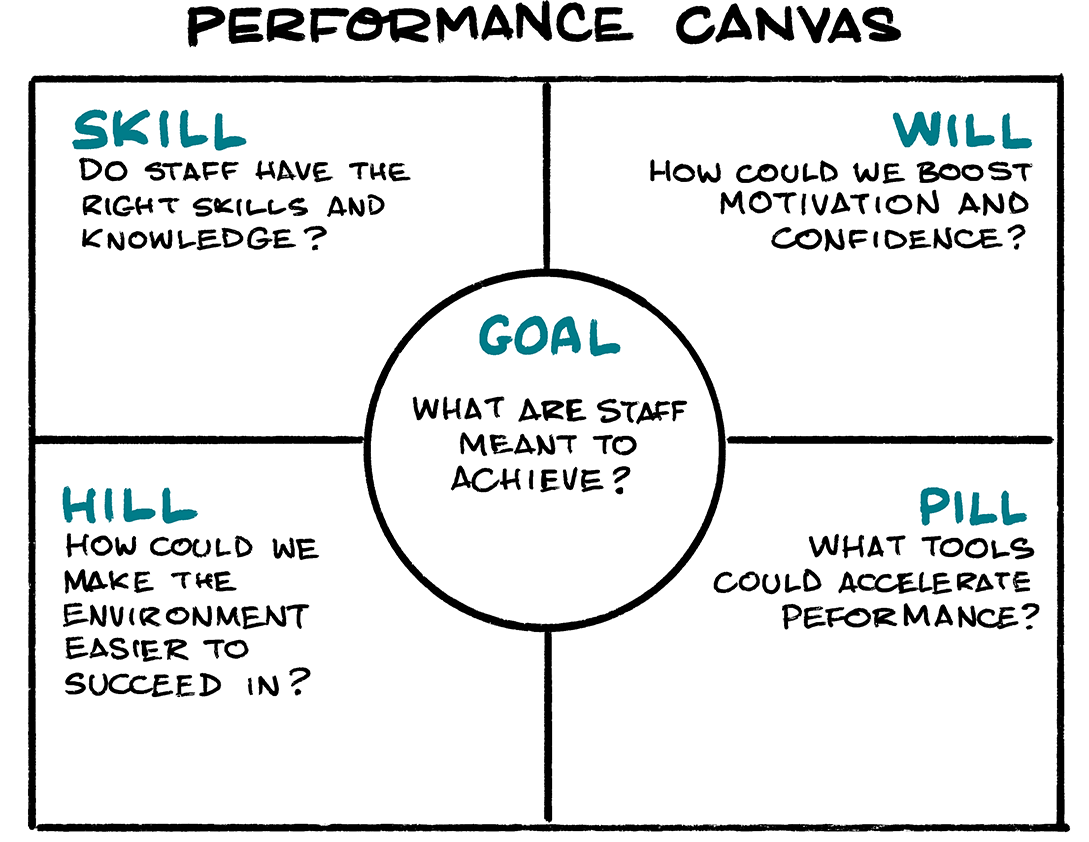
The main prompts of the Performance Canvas
What’s the Performance Canvas for?
I’ve always found this Performance Canvas is really useful for spotting gaps in a team's understanding about a change situation, and for stimulating a wider variety of solutions to help an organisation with performance and change. I like it because:
- It’s easy to remember;
- It's easy to draw up on a whiteboard or flipchart, or make in an online collaboration platform like Miro or Mural; and
- It encourages more strategic thinking
Here's a real example. I was once brought in by a client to do some training with some program managers on OKRs. I was told that they just didn't get it, and were holding back productivity, and if they could just do OKRs properly, it'd all be OK. When I probed into their thinking, it turned out that they hadn’t really asked those program managers how they saw the problem.
If reading that makes red flags go off for you, you’d be right! Turns out, the real issue was mostly about management swapping program managers from team to team all the time. The program managers’ productivity (and confidence) sunk with every new secondment, because each team worked a different way, and made decisions in different ways.
Here’s what this scenario looked like using the Performance Canvas:
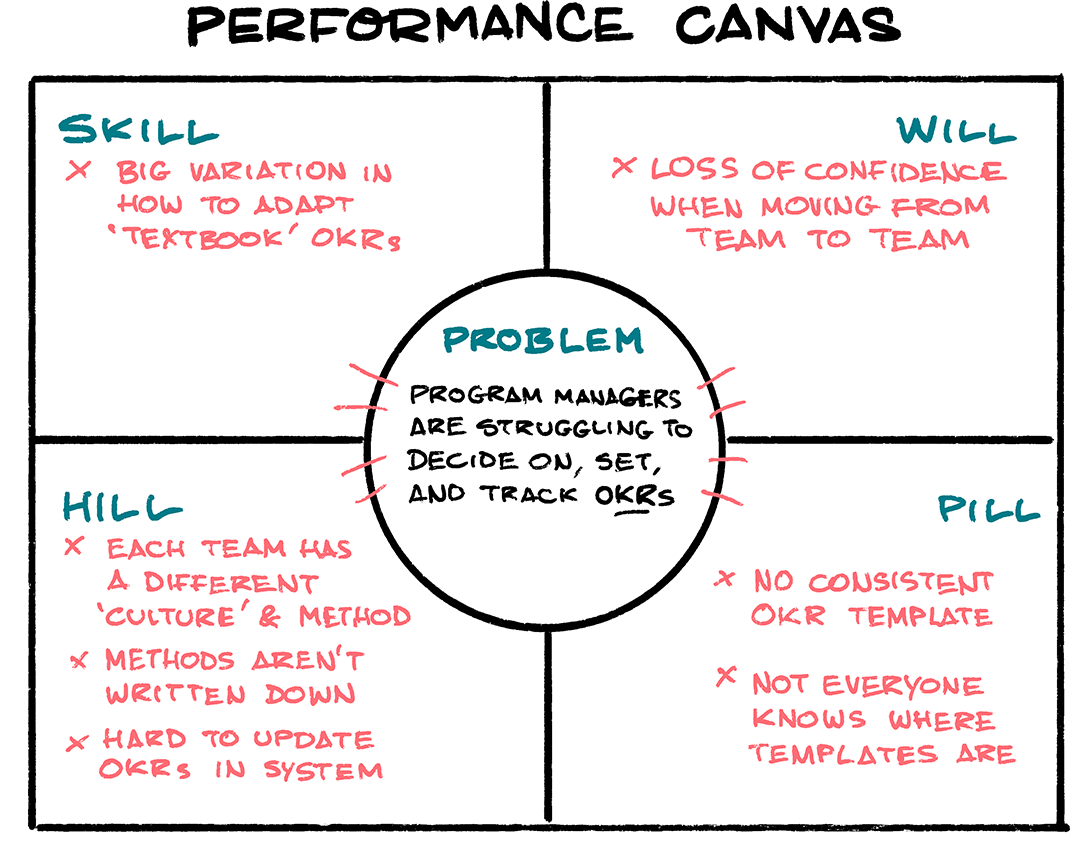
This Performance Canvas is adapted to be framed as a problem to be solved, and the information with each prompt is about WHY that problem is happening. This helped my client to reframe the problem from being the program managers’ ‘fault’ to being much more complex. This then helped them to think more strategically about solutions.
As you can see, the organisation's management thought that it was just a SKILL issue, but it turned out that it was more a WILL, HILL and PILL issue. Once management realised this, they hit pause on doing the training and instead did some 1:1 interviews and workshops to work out how to ‘reduce the HILL’ by standardising the OKR deciding, approving, and tracking processes. They also improved the PILL by updating the corporate playbook.
Oh, and then they still got me back later to do the OKRs training.
Using the Performance Canvas helped everyone — management and staff alike — to reframe the problem, and to invest in much more effective solutions that worked with the program managers, not against them.
Try it yourself
This is a framework I come back to time and time again, and each time I get to adapt in different ways. You might like to try it in these situations:
- In a kick-off session as a way to set a change program up for better success
- In a diagnostic and ideation session the next time you're facing some friction in in a change program
- Before a staff 1:1 session, to help you check in with that staff member at a more authentic level
- In a progress meeting if a project just seems... stuck, to get more specific on where the issues are
I'm keen to hear if you use the Performance Canvas, or if you adapt in new ways.